by Admin
08 Jan, 2026
Articles
Was Buddha Born in Nepal or India?
Why It Matters
Knowing the origin of Siddhartha Gautama adds context to the entire spiritual journey for the global audience—especially those drawn to Buddhist teachings, philosophy, or aesthetics. It provides geographical, cultural, and historical grounding to the life of a figure whose teachings have shaped centuries of thought, ethics, and meditation practices.
The birthplace of Siddhartha Gautama, the spiritual teacher who would become known as the Buddha, has long been the subject of academic inquiry and political contention. While most historical and archaeological evidence points to Lumbini, located in present-day Nepal, public discourse—particularly in South Asia—continues to reflect differing narratives. In the Western world, where Buddhism is often approached through the lens of spiritual curiosity or scholarly interest, this confusion is not just a matter of geography but of authenticity and cultural integrity.
Understanding where the Buddha was born is crucial for accurate historical record-keeping a nd appreciating Buddhism's deeper cultural and spiritual roots.
The History
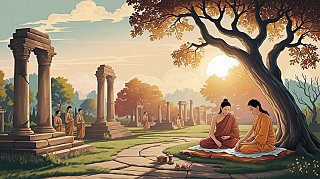
Siddhartha Gautama was born around 563 BCE into the Shakya clan, a small but influential tribe in the Himalayan foothills. According to the earliest Buddhist texts and a wide array of historical sources, Queen Maya Devi, while traveling to her parental home, gave birth to Siddhartha in Lumbini Grove. This garden was located within the borders of the Shakya kingdom, which corresponds to the Rupandehi District of modern-day Nepal.
The earliest definitive archaeological evidence of Lumbini's sanctity was unearthed in 1896. General Khadga Shamsher Rana of Nepal and German archaeologist Alois Anton Führer discovered a stone pillar bearing inscriptions in Brahmi script. This inscription is attributed to Emperor Ashoka, the 3rd-century BCE Mauryan ruler who embraced Buddhism and traveled to key sites associated with the life of the Buddha. The pillar's inscription reads:
"Here the Buddha, the sage of the kyas, was born."
This inscription, supported by subsequent archaeological discoveries—such as the remains of a shrine beneath the Maya Devi Temple dating back to the 6th century BCE—has led historians and UNESCO to formally recognize Lumbini as the birthplace of the Buddha.